![]() |
|
blog |
|
01 . 09 . 09 The Intermedia Catalogue is an archive of photographs, interviews and collected artifacts which together bear witness to what was arguably one of the most colourful and influential periods in Canadian art history. For five years, from 1967 to 1972, hundreds of individuals including artists, community resource people and administrators, worked together in an unprecedented effort, and in most instances without pay, to establish, support and promote an experimental artists’ workshop and to produce a popular and innovative program of performances and exhibitions. Collectively known as The Intermedia Society, this endeavour was founded by a core group of artist-friends and colleagues who began meeting early in 1967 in Vancouver. By mid-April they were awarded a grant of $40,000 from the Canada Council for the Arts. In June they opened the doors of the Intermedia artists’ workshop at 575 Beatty Street, downtown. This would be the first of three workshop venues in the city. From 1967 through 1970 Intermedia, with continued funding from the Canada Council, continued to produce experimental workshops, performances and exhibitions. By 1972 the society, already splitting into various interest groups, was dissolved. A number of these groups, including the Video Inn, Pacific Cinematheque, and the Western Front, have continued to be an important part of the Vancouver art scene to this day.
When I first arrived back in Vancouver after an extended visit to Montreal during Expo 67, I had friends who were already working at the Beatty Street workshop. As an artist in search of a context I found the openness and lack of proverbial red tape there attractive and I soon became involved myself. From the begining I felt that something important was happening at Intermedia, something fresh and promising. There was a notion that what we were doing would make a difference. Intermedia was a laboratory. It was in the world but set slightly apart from it. It was political. It challenged convention in the most fundamental way that encouraged artists to pursue the new and unconventional without fear or failure. It seemed to be the eye of the storm which had been brewing in society between established and counter-culture values. This underground nature of Intermedia lent a sense of privilege to my involvement, and as an artist with a camera I began to feel that the activity I was witnessing on a day-to-day basis needed to be recorded.
Intermedia was a turning point in my life as an artist. Prior to my involvement there I attended art school in the early ’60s and spent more than a few years testing my wits on and off the road across Canada and points further south. This was an initiation not unlike that of many of my contemporaries who, having grown up in the relative security of the 1950s, felt the need to dump it all in favour of a life which might be less predictable. At Intermedia in 1967 I was thinking about and working at photography. Associating with so many artists in various stages of their careers was amazing to me. There were those like myself at the beginning stages for whom Intermedia functioned like a school— without grades, of course, and without even any kind of organized curriculum. You figured out what to do and you did it, and if that didn’t work you tried something else. For those members who had already established art careers and professional reputations, Intermedia provided a context in which to radically re-evaluate and redefine their relationship with their work and with the art world. Although there wasn’t any obvious sense of hierarchy at Intermedia and people generally collaborated at a more or less equal level, it wasn’t Utopia. To some members there was an underlying, sometimes spoken but more often unspoken, dis-ease when it came to gender equality. By 1970 I had been awarded a Canada Council grant to do my work. I was receiving large commissions from national arts organizations and had exhibited my work at the Museum of Modern Art in New York. I was also giving workshops at internationally recognized institutions like the School of the Art Institute of Chicago. Essentially, the artist I had become had everything to do with my time at Intermedia. The Intermedia Catalogue is primarily a memoir. As noted earlier, Intermedia was the result of creative interaction between hundreds of people over a five-year period. My record of the Intermedia event represents the roughly three years, 1968-1970, during which I was most present there. My point of view during this time was very much shaped by the people I happened to be working and socializing with and by the events I attended. It was altogether subjective, disorganized and intuitive. The catalogue, therefore, must be considered as representing only a fragment of the Intermedia scene – a detail. The media environment of the 1960s had already become overwhelmingly dominated by corporate values and commodification. I had a sense that the more personal narratives, such as those which I had become an integral part of at Intermedia and which I felt would be a vital link to our collective cultural history, might easily be overlooked. I didn’t consider that what I was doing was professional in the sense of conventions or standards, or for that matter that it would be in anyway marketable, but I was very serious about it.
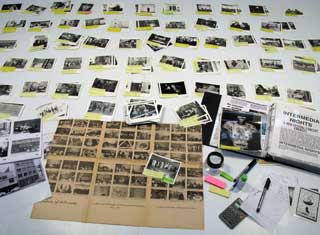
In 2003 I began the project which would become The Intermedia Catalogue. First, it was necessary for me to retrieve and re-organize the 150 rolls of black and white negatives which form the basis of my Intermedia archive. Most of these had never been printed. The negatives had been shot in rolls of 36 exposures. At the time they were developed, I had cut each roll into shorter lengths in order to fit them into the sleeves of glassine envelopes. My most pressing concern was that during 40 years of storage the glassine had become brittle and discoloured and the envelopes needed to be replaced. I also found that the negative strips had been moved around quite a bit over the years. There were many unidentified loose negatives and the individual strips from the rolls had been numerically shuffled within their envelopes. In addition, many rolls had been broken up and separated into three or four different envelopes. All of this confusion made any kind of methodical ordering next to impossible. I spent quite a few months going through these negatives and matching them up before placing them into new archival envelopes. Working on the light table, I would restore the order of each roll by matching film type, event or persons photographed, exposure numbers printed on each frame, and finally as a last resort, matching up the curve of the scissor cut at the end of each strip. My next task was to set the rolls in chronological order. This was an ongoing process which took several years to complete satisfactorily. But I had to start somewhere. After this rough-ordering stage was finished the next step was to make photographic prints of every negative in the darkroom. In order to create an archival record for at least 100 years I made the prints on fiber-based paper — three prints from each negative. In art-print convention, three is the minimum number if a print run is to be considered an edition. Also, I felt that having an edition of three would further enhance the probability of the archive’s survival. I made the prints 4"X5". I liked the intimacy of this size and felt that making these important images so small was a radical gesture. Working every morning for three hours, it took me a year to make 10,000 prints.
From the beginning of this project I decided that my Intermedia photographic archive would result in a website, an exhibition, a book, and a film. For this reason I made a point of printing everything. I wanted to capture every detail possible and even blurry and damaged pictures seemed important, especially when considered as frames in a movie. In the darkroom, watching these images being revealed, I found myself re-living the moments. Many forgotten things came back to me during this time and I made notes of those memories. Still, there was so much I could not remember. As my collection of prints grew I felt the need to reconnect and consult with the people in the pictures. Beginning in 2004 I met with everyone I could find who had been involved with Intermedia and made recordings of informal conversations while we viewed the photographs. At first, I spoke only with people who had been directly involved as Intermedia members. But as I traced the origins of the inter-media movement in Vancouver back through the 60s and 50s, the interviews recorded reflected increasingly diverse stories. When I finally wrapped up my research in 2007, I had spoken with 35 people and recorded 80 hours of conversation. An important component of the Intermedia story is the massive amount of press that the society generated during its five-year tenure. In 2004, with the assistance of Ed Varney (poet, archivist and Intermedia artist), I began to gather the full collection of Intermedia clippings. Ed had already accumulated a significant inventory of papers relating to Intermedia, including clippings, and other Intermedia friends shared their collections as well. I found many more by searching The Province and The Sun microfilm archives at the library. Then, over the course of the summer, I keyboarded all 74 clippings which chronicled Intermedia’s public activities in Vancouver from 1967-1970.
In 2005 I launched the website project INTERMEDIA1967, publishing my research to date. Over the next several years, working with my creative partner, web designer James Szuszkiewicz, I developed a number of transformative works based on my Intermedia photographic archive. Entitled Collaborations on the site, these are a series of animated works that are also intended as projections in a gallery installation. Also designed for the gallery is a large-scale screenprinted work entitled Souvenir: An Illustrative Guide to Vancouver Art History (1956-1968), which draws inspiration from important examples of pre-Intermedia ephemera including event invitations, posters, clippings, publications and personal notes. James and I have collaborated since 2004 on a number of other web projects including Hippie Vancouver and The Cellar, which are adjuncts to INTERMEDIA1967. All of this research positions The Intermedia Society within a larger historical context, beginning in the 1950s, as the flamboyant finale of a persistent, grassroots movement.
The list of Intermedia members here represents those people most active within the society during the late 1960s. (Prior to 1968 and post 1970 many people who may not be listed here were connected with the society. I have compiled a more expansive list of people involved in the inter-media movement in Vancouver from 1956 to 1972 in the archive section of my INTERMEDIA1967 site at www.michaeldecourcy.com ). The Intermedia Catalogue is dedicated to those who made it all happen, including... Werner Aellen Access The Intermedia Catalogue from the Michael de Courcy Projects portal at http://www.michaeldecourcy.com (click on The Intermedia Catalogue banner) or through the Vancouver Art in the 60s main page at http://vancouverartinthesixties.com/ (click on PROJECT SITES, then click on number 04: The Intermedia Catalogue).
From The Intermedia Catalogue home page you can reach the subsections of the site. These are: the introduction (a collage of thoughts and ideas about the Intermedia experience from various members of the society); 1968, 1969, 1970 (a chronological selection of photographs from my Intermedia collection which describes various themes and narratives played out at Intermedia over three years); the dome show (a concentrated look at documentation of Intermedia’s third, final and most ambitious exhibition at the Vancouver Art Gallery in 1970); voices (a series of 19 recorded conversations with individuals who were a part of the inter-media movement in Vancouver in the 1960s, including tributes to choreographer Helen Goodwin [1929-1987] and experimental filmmaker Sam Perry [1939-1966] ); stacks (a newly-created series of photographic animations linked to particular Intermedia projects, events and themes); clippings (a collection of 74 newspaper accounts of The Intermedia Society from its conception in 1967 to the dome show in 1970). If you are interested in discovering a larger context in which to view The Intermedia Catalogue, at the bottom of each of the site pages there is a link to The Michael de Courcy Archive which brings you directly to the INTERMEDIA1967 site. MdeC, New Westminster, http://intermedia.vancouverartinthesixties.com/
|
|
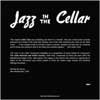
17 . 11 . 08 Jazz in the Cellar is a recently completed print work which I am dedicating to the The Cellar Musicians and Artists Society. This society and its subterranean jazz venue "The Cellar" was first in a succession of artist-initiated projects which now characterize our notion of the Vancouver underground in the 1960s. These artists' initiatives were not-for-profit organizations working in various collective models dedicated to experimental approachs to media. The most influential of these projects were The Cellar Musicians and Artists Society (1956-1963), the blew ointment press (1963-1969), the Sound Gallery / Motion Studio (1965-1966), the original Georgia Straight Newspaper (1967) and The Intermedia Society (1967-1972). Jazz in the Cellar tells the story of a veritable who's who of local and international players who preformed at The Cellar Club in the 50s and 60s. It also emphasizes the club's experiments in presenting live theater productions and jazz / poetry events. But perhaps even more importantly it reminds us that Al Neil's legendary music and performance work throughout the 60s and 70s in Vancouver is the thread which most readily connects The Cellar through the Sound Gallery / Motion Studio to Intermedia. MdeC, New Westminster,
| |
"a story of the increasing tension between Vancouver's general public and it's growing hippy population, hippie vancouver 1967 provides a vivid snapshot of the polarized social and political climate in which the Intermedia Society first opened it's artists' workshop in the summer of 1967." MdeC, New Westminster, 15. 10. 07 i n t e r m e d i a 1 9 6 7 The spring and summer of 2007 marked the 40th anniversary of both Vancouver's "hippie" summer-of-love happenings and the opening of the Vancouver Intermedia Society's artists workshop. Along with this apparent coincidence of timing, there is a deeper and more fundimental linkage which exists between these two seminal Vancouver events. The Vancouver hippie community and the city's multi-media artists scene evolved simultaneously, but although they were each preoccupied with separate and distinct agendas, they did on various occasions intersect and merge in highly productive ways. bill bissitt's groundbreaking poetry and visual arts magazine blew ointment press and later the Sound Gallery / Motion Studio's pioneering performance initiative, both stand out in the annals of Vancouver art history as examples of this effective artist / hippie alliance. And so, with regards to our generalized notion of 1960's "youth culture" or "the youth movement" of that day, hippie culture and multi-media art were in fact mutual and complimentary expressions of their time. Artists, poets, musicians and hippies in the 1960s often exhibited a shared taste in clothing, music and psychedelic drugs. These nonconformist youths, in the eyes of the general public, were outwardly all but indistinguishable from each other. The artist members of the Intermedia Society identified with the hippie community and its struggle. It is ironic, and an indicator of the level of anti-hippie rhetoric at the time, that as the Society prepared to open its doors to the public, it felt it necessary to disassociate from the hippie movement, with which psychedelic drug use was closely linked. According to artist Jack Shadbolt, a founding member and one of the society's main early spokespersons, Intermedia was to be considered "educational" and "serious..." "Shadbolt said Intermedia, which will deal amongst other things, with electronic exploration in sound and light, is a pioneer in it's field in Canada — and it is for this reason that the Canada Council is so interested."
THE PROVINCE : Sunday, April 15, 1967
On April 21, 1967 in an interview with CBC radio Intermedia was asked weather their proposed workshops might resemble a sort of 21st century community center and / or a hide out for hippies, founding member Joe Kyle responded by describing the kind of environment which he hoped Intermedia might provide ... "creative exploration could take place on an interactive basis between artists, between technologists and between seriously interested people." " i don't think it's very desirable to try and define Intermedia in too great detail at the moment because its exploritory we are in a sense discovering this thing into existence... " for the complete interview click here
|
|
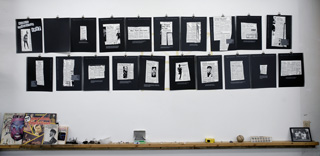
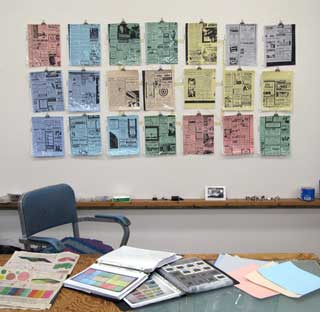
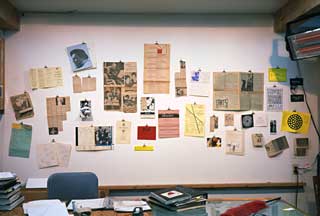
7 . 23 . 06 I continue to pursue, collect and examine public and personal documentary material pertaining to the early beginnings and subsequent development of Intermedia art practice in Vancouver. In conjunction with and as a direct result of this investigation I am currently producing a large installation work composed of original screenprints which are based directly on this Intermedia archival material. I am calling this new work; Souvenir / an illustrative guide to Vancouver art history (1956—1967). Souvenir, traces an unfolding trail through Vancouver art and culture of the 1950,s and 1960's leading directly to the creation of the Intermedia Society and the opening of it's public workshop for the exploration of art and technology on Beatty Street in 1967. An assemblage of collected ephemera including; programs, posters, newspaper clippings, reviews and ticket stubs etc., Souvenir is a spectator's view of important cultural objects and events: art history by the people for the people.
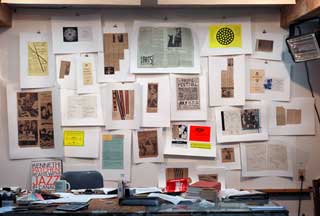
Click on the individual screenprints above to enlarge
|
|
| http://www.michaeldecourcy.com | |